
Huron Projected Versus Actual Release
A projected date is an estimate or legal milestone based on the sentence record as it then stands. An actual date records the event that occurred. Michigan’s public state system uses more exact terms. The Parole Board Jurisdiction Date, also called the Earliest Release Date or ERD, is the first date the Board may obtain jurisdiction. It is not a guaranteed prison exit. Date Paroled records a later parole event, while Maximum Date concerns the controlling maximum.
A pretrial detainee is different. No sentence calculation can supply a fixed release date before the court resolves bond or other authority for custody. Even after a judge enters a bond or release order, jail processing and a second hold may delay or prevent community release. The Huron County Jail’s movement record is the best local evidence of when the person actually left and whether the departure was release or transfer.
- ERD
- Earliest Release Date, the term Michigan also uses for Parole Board Jurisdiction Date.
- Maximum Date
- The potential maximum expiration under the controlling sentence and lawful credit rules.
- Date Paroled
- The date state prison release on parole occurred or parole status was conferred.
- Detainer
- A notice or hold from another authority that may lead to continued custody or transfer.
Find Huron County Release Dates
Start by classifying the case. OTIS is the principal public source for a current or recent MDOC prisoner, parolee, or MDOC-supervised probationer. It does not cover a person sentenced only to Huron County Jail. A county sentence must be traced through the written court sentence, jail credit, any commitment or release order, and the jail’s actual movement record.
- Determine whether the person is pretrial, serving a Huron County jail sentence, or under an MDOC prison sentence.
- For MDOC custody, open OTIS and search by the unique MDOC number when known, or use at least the last name.
- Match the person by identifiers and sentence data. Read Parole Board Jurisdiction Date/ERD, Maximum Date, status, and Date Paroled when present.
- For a local jail term, obtain the sentence and jail-credit information from the proper Huron court, then ask the jail how that order applies to the person’s movement record.
- For a pretrial hold, follow bond and court events, but confirm the physical exit with the jail.
- When a date or sentence is wrong, take sentencing data to the sentencing court and status or supervision issues to MDOC or the listed office.
The OTIS field guide states that the public interface may lag and explains each status. PRISON usually means incarceration, though the location details can show an unusual placement. PAROLE means prison release with continuing MDOC supervision. DISCHRG means MDOC jurisdiction has ended for the sentence, subject to the reason and date shown.
The official OTIS search shows the fields used to locate a Michigan state record:
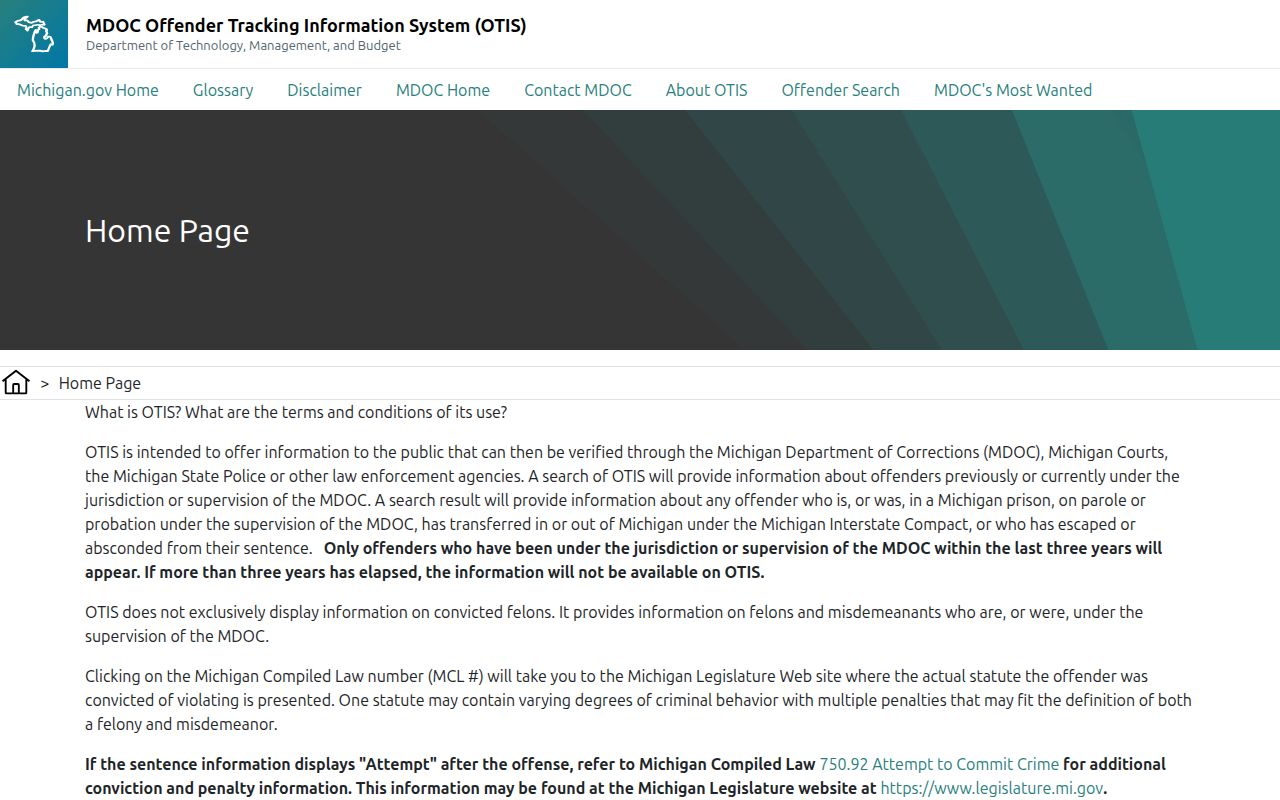
The screenshot helps identify the correct state search, but Huron jail-only cases still require county and court records.
Note: OTIS date labels can differ from older MDOC materials, so rely on the definition beside the current field.
Michigan Rules for Huron Release Dates
Michigan’s truth-in-sentencing framework does not supply a general 85-percent formula. The official MDOC explanation says prisoners with covered sentences must serve the full court-imposed minimum before parole consideration. It applies to specified assaultive crimes committed on or after December 15, 1998, and other covered crimes committed on or after December 15, 2000. Disciplinary time replaced credits against the minimum for those sentences.
MCL 791.234 distinguishes disciplinary-time prisoners from older credit-eligible cases and sets parole-jurisdiction rules. MCL 800.33(14) bars a disciplinary-time prisoner from good time, special good time, disciplinary credits, and special disciplinary credits. That means a current sentence cannot be shortened by copying a simple percentage from another state. The offense date, conviction statute, sentence type, and governing law all matter.
Legacy schemes can still affect an older sentence visible in OTIS. MDOC’s glossary describes disciplinary credits in general as five days per month, with up to two added days for exceptional conduct and an annual maximum of 84 days. Credits can be lost for major misconduct. Older good-time law used a scale based on sentence length and did not apply to crimes committed after April 1, 1987. These rules require the actual sentence record and should not be applied through a public calculator.
The judgment of sentence supplies the minimum and maximum framework. Consecutive sentences, jail credit, misconduct, offense date, corrections to the judgment, and legal exclusions can alter the displayed dates. MCL 791.233 also requires the Parole Board to assess release criteria. The Board may deny or defer parole even when jurisdiction has begun.
Life sentences require separate care. MCL 791.234 contains detailed jurisdiction rules for parolable life terms and excludes some crimes from ordinary parole. A public date should never be inferred from the sentence label alone. Read the conviction statute and judgment, then use the Board and MDOC records that apply to that sentence. Nonparolable cases follow the distinct lawful routes stated in the governing law.
Huron Release Dates Can Change
No single field freezes every later event. A court may correct a judgment. An older credit-eligible prisoner may lose credit through misconduct. Another jurisdiction may lodge a hold. The Parole Board can grant, deny, or defer, while release planning may affect the final event. MDOC says the Parole Release Unit needs at least 28 days between a Board decision and physical release, so a grant is not the same moment as departure.
| Factor | How it affects the date | Best source |
|---|---|---|
| Parole decision | Eligibility may lead to a grant, denial, or deferral rather than immediate release | Michigan Parole Board and OTIS |
| Release planning | Placement and coordination occur between decision and physical departure | MDOC and assigned office |
| Misconduct | May affect legacy credits or be weighed as disciplinary time | MDOC record under the governing law |
| Consecutive sentences | Can shift the controlling jurisdiction and maximum calculations | Judgment and MCL 791.234 |
| Detainer or outside hold | Can cause transfer or continued custody after one sentence allows departure | Holding and receiving agencies |
| Court correction | Can change sentence data that OTIS is directed to reflect | Sentencing court and MDOC |
A screenshot or copied date shows what a system displayed at that time. It is not a certificate that no later order or correction occurred. When OTIS and the sentencing docket conflict, the court addresses court-derived data and MDOC addresses custody-derived data.
Huron Jail Release-Date Records
OTIS does not calculate Huron County Jail release dates. For a local sentence, request the written sentence, jail credit, commitment or release order, and the jail’s final movement entry. Huron County publishes no county-jail good-time formula, weekend-release rule, or release-date calculator. Applying MDOC prison law to a county jail term would produce an unsupported answer.
The Sheriff’s jail page lists (989) 269-6424. Ask whether the person remains in Huron custody. If not, ask for the recorded departure date and whether the movement was community release or transfer. The Sheriff Records Office and Sheriff FOIA form are the documentary fallback. A narrow request can seek the booking identifier, release date and time, disposition or reason, and receiving agency when recorded and disclosable.
Court jurisdiction also matters. The 73B District Court handles misdemeanors and felony arraignments or preliminary examinations. A felony bound over proceeds to the 52nd Circuit Court for final adjudication and sentencing. A court order shows legal authority. The jail record shows physical processing. Compare both when timing matters.
The full Huron County release-record path explains how to reconcile the Sheriff movement, court event, and receiving system without treating a transfer as freedom from all custody.
Huron Work Release Is Custody
Huron County’s official work-release rules illustrate a local date trap. Work release permits approved activity outside the jail setting while the person remains a program participant in custody. The rules limit work activity to Huron County and require at least one full 24-hour day in jail. Going to work is therefore not sentence discharge and should not be entered as an actual release date.
A person may also be outside a cell under tether or another court program while legal restraints continue. Use the program order and responsible office to understand the status. For work release, the jail and court remain the key sources. For local probation, 73B District probation may have the relevant supervision detail. None of these arrangements should be converted into an MDOC Date Paroled.
The Huron County work-release rules are the official source for the program’s local limits. They supply context for movement, not a public list of participants or a release forecast. Ask the responsible office about the actual case rather than applying a generic schedule.
Note: Physical movement for work, treatment, court, or transfer is not the same event as release from legal custody.
Confirm Huron Inmate Release Dates
For MDOC cases, distinguish three questions. Parole Board Jurisdiction Date or ERD asks when the Board may first have authority. Date Paroled asks when prison release on parole occurred. Maximum Date concerns the outer term under the controlling sentence and lawful credit rules. Read status and location beside the date because the terms answer different questions.
For a Huron County jail case, use the court order for legal authority and the jail movement for the physical event. If the movement says transfer, follow the named receiver. OTIS applies after MDOC intake, BOP tools apply to federal sentenced custody, and ICE has a separate civil custody locator. A missing record in the wrong system has little value.
MI-VINE can provide a timely cue when a participating source reports a change. Registration steps and PIN rules are explained on the Huron County VINELink release check. Treat the notice as the time to verify. The jail, court, or MDOC record remains the source for a durable answer.
If OTIS shows PAROLE, the person has left prison but remains supervised. If it shows DISCHRG, read the reason and date before concluding that the end of MDOC jurisdiction was recent. Discharge records generally remain visible for three years, with lawful set-aside and removal exceptions. Older events may require the sentencing court or an agency records request.