
Huron County MI-VINE Coverage
Michigan calls its service MI-VINE and uses VINELink as the online entry. The service is free, confidential, and available at all hours. Participating county jail data may report a person’s custody status and events such as release, transfer, or escape. Some court-event information can be keyed to a Criminal Case Tracking Number. Coverage depends on the agency record sent into the system.
Huron County does not publish an official online jail roster or recent-release feed. MI-VINE is therefore useful as one event channel, but it does not become the Sheriff’s permanent release log. A county alert should be paired with the Huron County Jail or Sheriff Records Office. A state prison event should be checked through MDOC. Court disposition belongs in the relevant Huron court record.
The distinction also protects against a common namesake error. Search results for Huron County can lead to an Ohio sheriff roster, but that is not a Michigan custody source. A valid local result should fit the Michigan selection, Bad Axe agency context, and the person’s known booking details. If those signals do not agree, stop and verify the state before registering an alert.
| Custody path | Use of VINELink | Confirm with |
|---|---|---|
| Huron County Jail | Participating custody and movement alert when a matching record is available | Jail, Sheriff release record, and court |
| Michigan state prison | Related victim notification services, with a distinct formal MDOC path | OTIS and MDOC |
| Federal prison | Not a substitute for federal custody data | BOP Inmate Locator or BOP records |
| ICE custody | Not an ICE locator | ICE Online Detainee Locator and ICE |
The official Michigan MI-VINE page identifies its state brand, event coverage, and notification service:
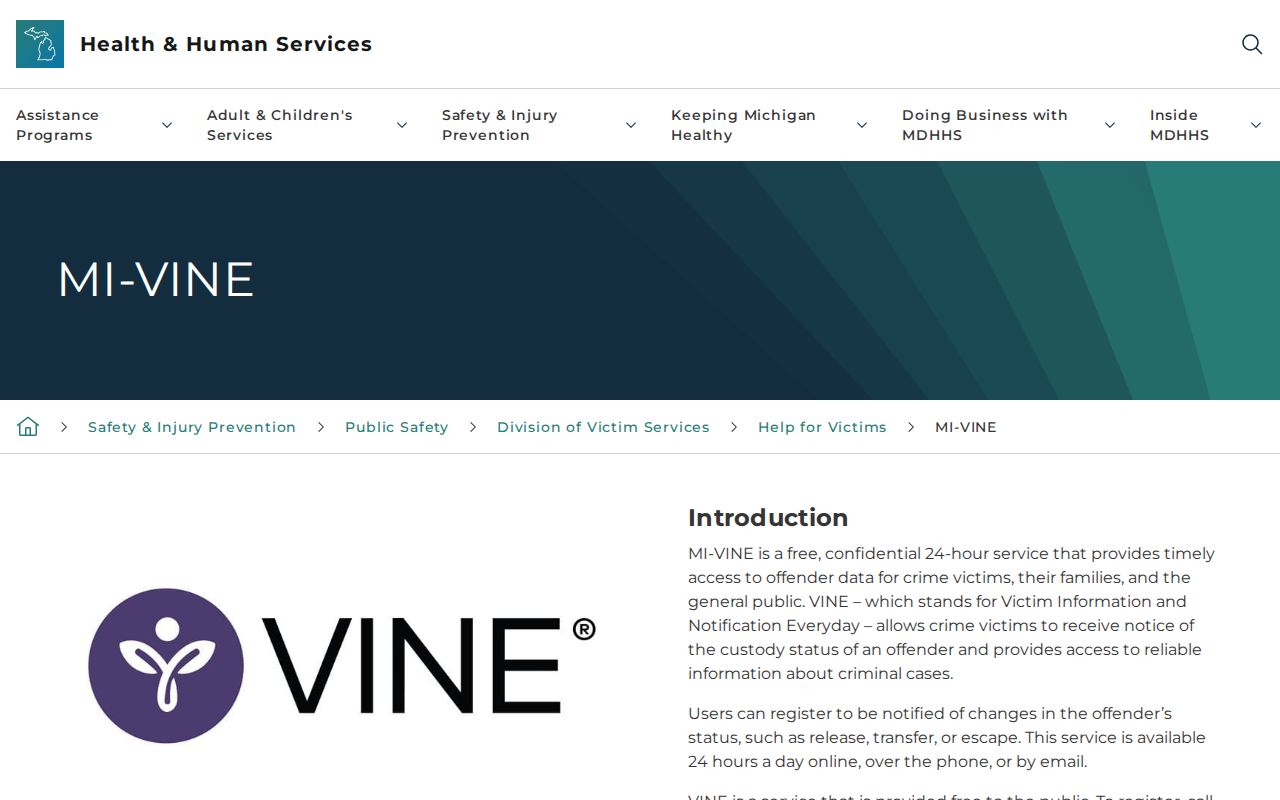
The state page supports use of MI-VINE as a notice channel while also warning that direct confirmation remains necessary.
Search Huron County on VINELink
Use VINELink for a specific person, not as a list of everyone released in Huron County. An offender or booking number is the strongest starting point because names can be shared or entered in more than one form. When only a name is known, compare all identifiers shown before opening notification settings. A near match is not enough.
- Open VINELink and choose Michigan as the state.
- Select the offender or custody search for the person being followed.
- Enter the full name or offender/booking number. Prefer the number when it is available.
- Review candidate records and reconcile the identity. Do not choose a record solely because the surname matches.
- Open the matching record and read its reported custody status and location.
- If the result says released, contact the Huron jail and relevant court, or MDOC for a state case, to confirm what changed.
A released result means the source system reported a custody change. It does not say that every hold ended, every sentence was discharged, or the person entered the community. Transfer to another custodian can remove someone from the sending facility while custody continues. Ask the jail to classify the movement.
The public VINELink entry screen provides the state selection and one-person search route:
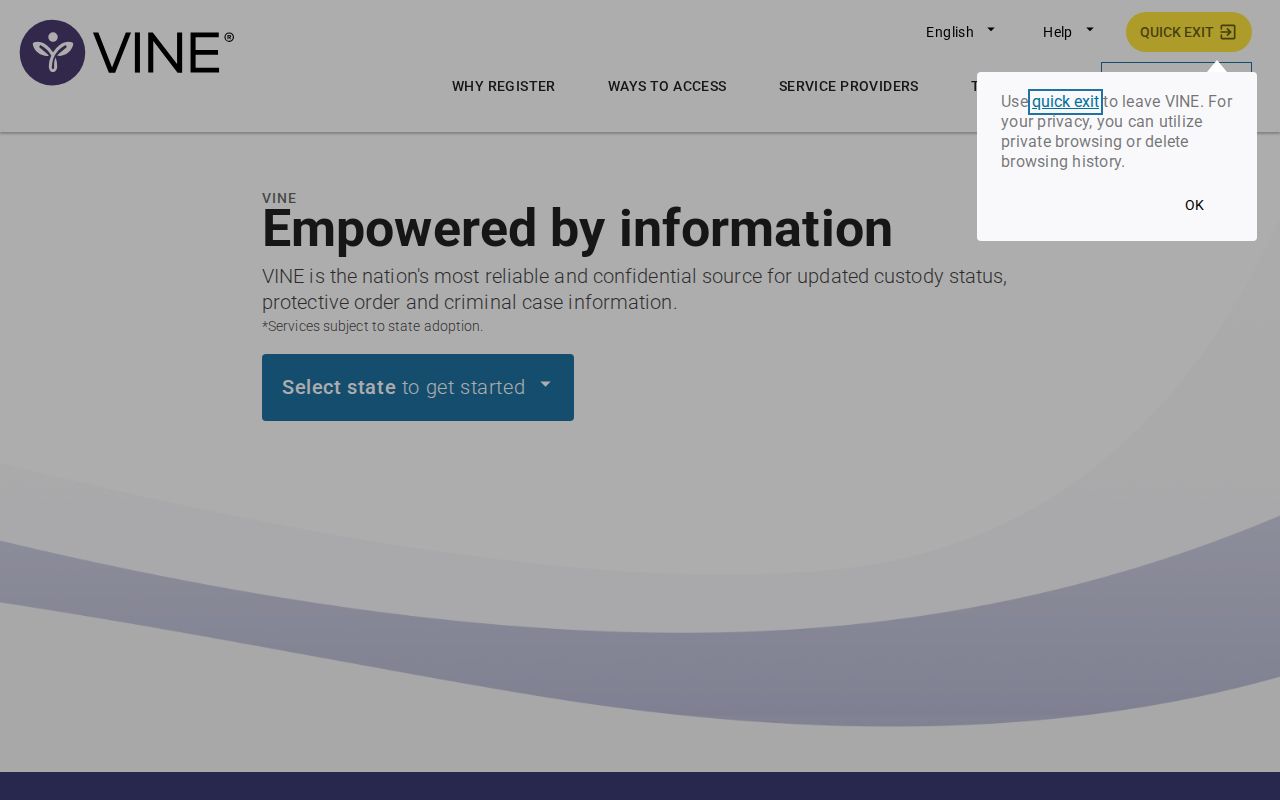
The screen is the starting point for a matching record, not proof of release until the reported event is checked with its source.
Note: Search results and interface labels can change, so retain the offender number and record the time of any alert received.
Huron VINELink Release Fields
MI-VINE is event oriented. It reports what a participating agency sends and can notify a registered user when that record changes. It should not be read like a full Sheriff booking sheet, court file, or MDOC sentence record. The exact live display varies by record type, so only fields supported by the Michigan research should be expected.
| Field or event | What it can show |
|---|---|
| Name or offender/booking number | The identity keys used to find and reconcile the participating record |
| Custody status | The status most recently reported by the source agency |
| Location | The reported custody location, when supplied |
| Release event | A reported departure or status change that still needs agency confirmation |
| Transfer event | A move that may continue custody under another facility or authority |
| Escape event | An alert, not a lawful release |
| Court event or CTN | Participating case information that does not prove the exact time of physical exit |
For Huron County jail-only cases, OTIS is not the next automatic step. OTIS excludes county-jail-only prisoners. Call the jail, compare the court event, and request the movement record if durable proof is needed. For an MDOC case, OTIS can show PAROLE, DISCHRG, Date Paroled, location, and sentence fields. The correct system follows custody, not the county where the case began.
A court event has its own limit. MiCOURT may show bond action, dismissal, sentence, or case closure, but a docket is not an electronic sensor at the jail door. Legal authority can appear before staff complete a movement, and a separate hold can remain. Use the docket to explain why a change was authorized, then use the Sheriff movement record to establish what physically happened.
Register Huron County Release Alerts
Registration must be attached to the correct matching record. MI-VINE allows telephone, text, and email destinations, including more than one destination. Telephone alerts use a four-digit PIN so the recipient can acknowledge the call. Choose a number that can receive and acknowledge automated calls. A switchboard may not work.
- Open the matching person’s record and choose the notification or registration control.
- Select telephone, text, email, or a mix of channels, then enter each destination.
- Create a four-digit PIN for telephone notices and keep it with the offender or booking number.
- Finish the on-screen confirmation so the registration is saved.
- When a call arrives, enter the PIN to acknowledge the message.
- If the PIN is lost, call 800-770-7657 and press 0 for help.
The official MI-VINE brochure says telephone calls may repeat until acknowledged or for up to 72 hours. A call may leave a message and can arrive overnight. That repetition is a service feature, not evidence of repeated releases. Read the event in the message, note the time, and call the responsible agency.
MI-VINE’s main number is 800-770-7657. TTY service is 866-847-1298. These contacts help with the notification system. They do not replace the Huron County Jail for a local movement record or MDOC for a state parole or discharge record.
Huron Transfers Need New Coverage
Michigan distinguishes self-registration for participating county-jail events from the formal MDOC notification path for state-prison cases. This difference is especially important when a Huron County booking ends in transfer to MDOC rather than release to the community. A county registration should not be assumed to follow the person through state intake and every later prison event.
When the Huron jail identifies MDOC as the destination, search OTIS after state intake and ask about the proper MDOC notification process. Keep the county booking number for the Sheriff record and the MDOC number for the state record. Those identifiers describe separate systems and may appear on different timelines.
The formal distinction affects future alerts. A user who registered for a participating Huron County jail record should review the Michigan MI-VINE instructions again after transfer and follow the state-prison notification route that applies. Do not wait for the old county registration to prove that it has been carried forward. Confirmation at the change in custody prevents a gap in expected notices.
A similar rule applies to other transfers. Federal sentenced custody belongs in the BOP locator. ICE custody belongs in ICE’s locator. Another county’s jail must be checked with that county. VINELink can prompt the next check, but it does not merge those authorities into one complete custody history.
Note: Recheck notification coverage whenever the Huron County Jail reports transfer to MDOC or another agency.
Confirm Huron VINELink Releases
Automated data can lag at entry, transmission, or display. Michigan warns users not to rely on MI-VINE alone. For a Huron County jail event, call the jail and ask whether the person remains there. If not, ask whether the departure was release to the community or transfer, and request the recorded destination when disclosable. The Sheriff booking/release record supplies the more durable movement evidence.
Next, compare the legal source. The 73B District Court handles misdemeanors and early felony proceedings. A felony bound over to the 52nd Circuit Court receives its final disposition and sentence there. A bond entry or release order can explain legal authority, but it does not prove the exact moment jail processing ended. The court and jail answer different parts of the question.
For state custody, read OTIS status and date fields, then contact MDOC or the listed field office if the record is unclear. PAROLE means prison release with continuing MDOC jurisdiction. DISCHRG means the sentence is no longer under MDOC jurisdiction, subject to the reason shown. The broader Huron County released-inmate search sets out the full county, court, state, federal, and immigration chain.
Older events need a different approach. VINE is designed around alerts and participating current data, not a permanent archive of every movement. A dated Sheriff request or court file may remain useful after an alert is no longer displayed. For an MDOC discharge, OTIS generally keeps the public record for three years after the most recent discharge unless a lawful removal rule applies.
- Alert
- An automated notice that a participating source reported an event.
- Transfer
- A move from one custodian to another, not necessarily community release.
- Parole
- Release from state prison while supervision and the sentence continue.
- Discharge
- The recorded end of the responsible agency’s jurisdiction for that sentence.