
Huron County Parole and Probation
Parole and probation both place rules on a person in the community, yet they begin in different ways. Parole follows a state prison term. The Michigan Parole Board authorizes the person to leave prison while Michigan Department of Corrections jurisdiction continues. Probation is imposed by a court instead of, or along with, a jail term. An MDOC-supervised felony probationer can appear in OTIS, while a person on local misdemeanor probation may have no OTIS entry at all.
That split is important in Huron County. State parole and MDOC probation are handled through Field Operations. The 73B District Court handles local probation tied to misdemeanor and court programs. A person may be out of a cell and still be supervised. Tether, work programs, community service, and parole all have different legal bases, so the office named in the case record should control the inquiry.
| Feature | Parole | Probation |
|---|---|---|
| How it begins | Michigan Parole Board release from state prison | Court order, sometimes with a jail component |
| Huron source | OTIS and MDOC Huron Parole/Probation | OTIS for MDOC cases, or 73B District probation for local cases |
| What release means | Out of prison but still under MDOC jurisdiction | In the community under court rules, unless jailed on another matter |
| How it ends | Discharge, maximum discharge, or another lawful end | Court or MDOC discharge, depending on the case |
- Parole
- Conditional release from state prison while the sentence remains under MDOC control.
- Probation
- Community supervision ordered by a court, with rules and a set term.
- Discharge
- The end of the supervising agency’s jurisdiction for the recorded sentence.
- Absconder
- A person reported as having stopped complying with supervision and whose location is not known to the agency.
Verify Huron County Supervision
Begin with the type of custody that preceded release. A person paroled from a Michigan prison should be searched in MDOC OTIS. Use the MDOC number when known because it identifies one record. A last name also works, with filters for age, sex, race, status, and identifying marks. Match more than the name before relying on a result.
- Decide whether the case involved state prison, MDOC felony probation, or 73B District Court supervision.
- For an MDOC case, search OTIS and open the record that matches the person’s identifiers and sentence information.
- Read the status, Date Paroled, location, and any discharge data. A future jurisdiction date is not proof of parole.
- For a local misdemeanor case, review the court docket and contact 73B District probation instead of assuming OTIS should contain it.
- Ask the named office to resolve a supervision-location error or an unclear status. The supervising office is better placed than a general switchboard to confirm its own record.
The Huron County released-inmate search and records path explains how jail movements and court dispositions fit beside supervision data. It helps when the original custody type is not clear.
Review the official OTIS field guide before treating a label as a conclusion. The guide explains that PAROLE means physical prison release with continuing supervision, PROB means MDOC-supervised probation, and DISCHRG means MDOC jurisdiction ended. Discharged records generally remain public in OTIS for three years after the most recent discharge.
The official OTIS field guide shows how Michigan distinguishes parole, discharge, and its date fields:
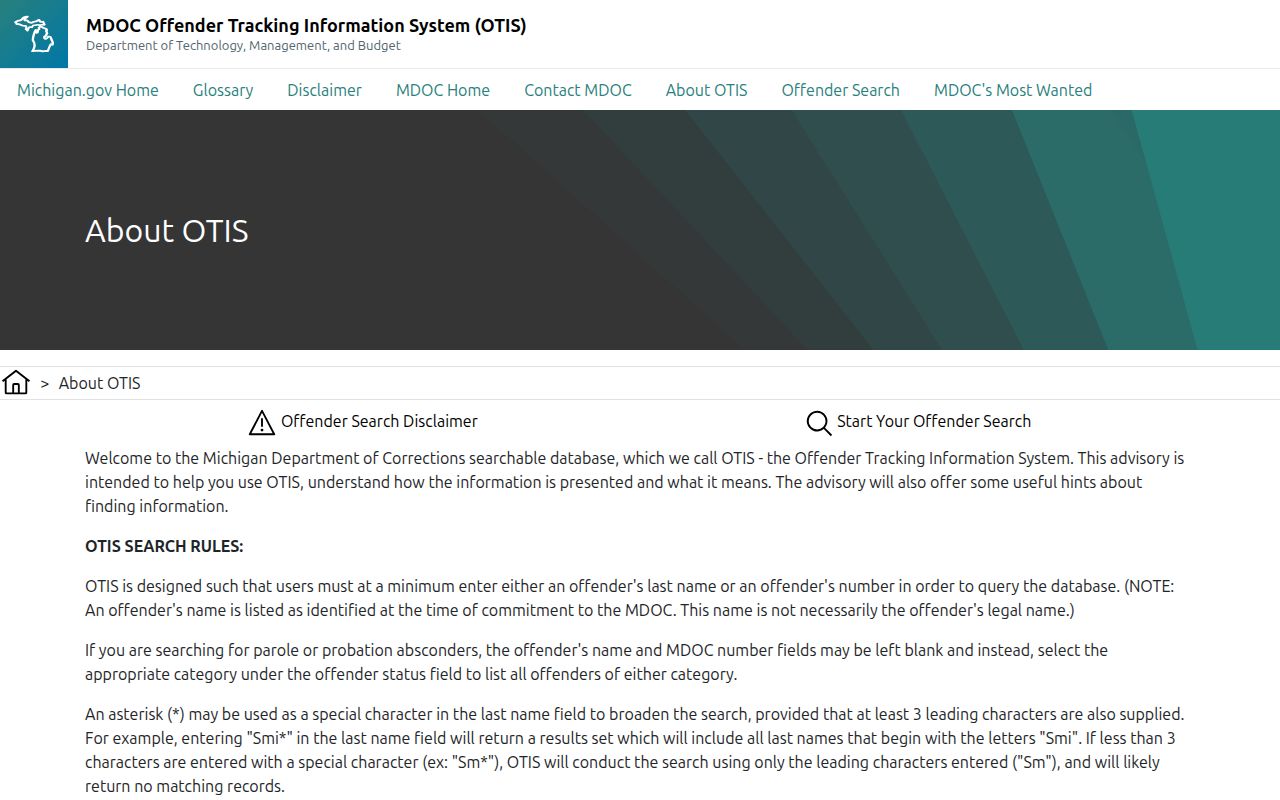
The labels in that image help separate an actual Date Paroled from an eligibility date or a later discharge.
Note: An OTIS location for an absconder may name the last supervising office, not the person’s current physical location.
Two Huron Supervision Offices
Huron County has two local channels that should not be merged. The MDOC Region 6 directory lists the combined Huron Parole/Probation office for state cases. The 73B District Court probation page identifies the local court contact. Both are in Bad Axe, but they answer to different authorities and cover different case types.
MDOC Huron Parole/Probation250 E. Huron Avenue, Room 310
Bad Axe, MI 48413
(989) 269-9975 73B District Court Probation
Jesse Osentoski
250 E. Huron Avenue
Bad Axe, MI 48413
(989) 269-9530
Call MDOC for state parole or MDOC-supervised probation. Contact 73B for local misdemeanor probation and related jail, tether, work-program, or community-service matters. If a felony began in District Court and was bound over, the final sentence belongs in the 52nd Circuit Court record. Office identity is more reliable than a guess based only on the word “probation.”
Huron Parole Review Records
The Michigan Parole Board is the sole paroling authority for felony offenders committed to MDOC. Ordinary review often begins about six months before an eligibility or reconsideration date. Interviews generally occur by secure video with one Board member, followed by a majority decision from a three-member panel. Life cases use the full Board. A grant, denial, or deferral is a Board outcome, but only a later Date Paroled proves that prison departure occurred.
Michigan does not publish a full calendar of ordinary individual parole interviews. The public hearing registration page covers exceptional named clemency, pardon, and commutation matters. It is not a routine parole docket. Aggregate quarterly reports count interviews, grants, denials, and deferrals, but they do not verify one person’s release. OTIS plus MDOC confirmation remains the direct person-specific route.
For the exceptional public matters that are listed, MDOC says notice may appear from about two weeks to 30 days before the hearing. Registration closes no later than two business days before it. The online instructions direct attendees to join early with video off and sound muted, and they bar recording, photographs, or screenshots of the proceeding. Those rules apply to the limited public process, not to an ordinary Huron County parole interview.
MCL 791.234 controls jurisdiction and eligibility rules, while MCL 791.233 addresses release criteria. Eligibility does not compel release. A denial may set a later reconsideration date, and some offenses are not eligible for ordinary parole. These limits are why a projected jurisdiction date should never be recast as an appointment to leave prison.
Huron Supervision Status Changes
Supervision conditions are the rules a person must follow. They are set by the proper authority and can include reporting, location, treatment, or other case-specific duties. The public OTIS record is a status aid, not the full set of conditions. A violation can lead to added review, a warrant, revocation, or renewed custody, but the outcome depends on the agency and case.
OTIS uses ABSCOND1 for a parole absconder sought by MDOC and ABSCOND2 for a probation absconder under the sentencing county’s jurisdiction. Absconding is not a lawful discharge. MDOC’s FAQ lists the Absconder/Escapee Tip Line at 517-755-0855 for information about whereabouts. An urgent safety matter belongs with emergency services, not a record-search portal.
MI-VINE can send participating custody alerts, yet it should not be used alone to decide whether supervision ended. Jail release, transfer, parole, and discharge are separate events. Read the source named in the alert, then confirm the event with the jail, court, or MDOC office that owns the record.
Note: A parolee may return to custody after a violation, so an older Date Paroled does not prove present community status.
Huron Parole Reentry Support
Huron County’s state reentry path runs through the assigned agent and the local MDOC office. MDOC Reentry Services describes In-Reach and Offender Success work that connects people returning from prison with agents and partner resources. The Parole Release Unit also coordinates releases to community placements. These programs help with transition, but participation is not proof that a named person was released.
The Huron County Prosecutor’s victim-services resources identify local behavioral, human-development, legal, and transportation contacts. A person seeking help after release should work through the assigned agent when a parole condition may affect the service or placement. The agent can explain what is permitted under the actual case. Public resource lists cannot change an order or supervision term.
This local layer matters because the county has no state prison. A person returning to Huron County may have left an institution elsewhere in Michigan, while their supervision location moves to the Bad Axe office. OTIS tracks the state record; local partners address needs in the community. Neither role replaces the other.
Ending Huron County Supervision
Discharge is the recorded end of jurisdiction, not merely a move out of prison. In OTIS, PAROLE reflects continued MDOC authority after physical release. A later DISCHRG status can mark successful completion, maximum discharge, or another recorded end. Read the reason and date because OTIS can also retain a record after death. Never assume the label describes a recent walkout from custody.
For local probation, the court record and 73B probation office control. Completing a jail term does not automatically close a separate probation term. Likewise, paying a bond does not end a pending case. Ask for the court order or docket event that records completion when a durable answer is needed.
A three-year OTIS display period for many discharged MDOC records explains why an older completed case may no longer appear there. Set-aside or removal by operation of law can also change public access. Preserve a lawful record through the originating agency when needed, and respect any sealed or nonpublic status.